
Gurltia paralysans infection in a domestic cat in the São Paulo state, southeastern Brazil

Authors

  • Rafael Rocha Mello Emboaba da Costa Graduação em Medicina Veterinária, Faculdade de Ciências Agrárias e Veterinárias (FCAV), Universidade Estadual Paulista (UNESP) Author
  • Júlio Edward Hough Monteiro Laboratório Novolabvet, Ribeirão Preto, SP, Brasil Author
  • Claudia de Souza Silva Programa de Residência em Área Profissional da Saúde – Medicina Veterinária e Saúde, FCAV-UNESP, Campus de Jaboticabal, SP, Brasil. Author
  • Fernanda Ramalho Ramos Programa de Residência em Área Profissional da Saúde – Medicina Veterinária e Saúde, FCAV-UNESP, Campus de Jaboticabal, SP, Brasil. Author
  • Bethânia Almeida Gouveia Programa de Residência em Área Profissional da Saúde – Medicina Veterinária e Saúde, FCAV-UNESP, Campus de Jaboticabal, SP, Brasil. Author
  • Paulo Henrique Leal Bertolo Departamento de Patologia, Reprodução e Saúde Única, FCAV-UNESP, Campus de Jaboticabal, SP, Brasil. Author
  • Rosemeri de Oliveira Vasconcelos Departamento de Patologia, Reprodução e Saúde Única, FCAV-UNESP, Campus de Jaboticabal, SP, Brasil. Author

DOI:

https://doi.org/10.24070/bjvp.1983-0246.v16i2p108-111

Keywords:

chronic myelopathy, feline diseases, gurltiosis

Abstract

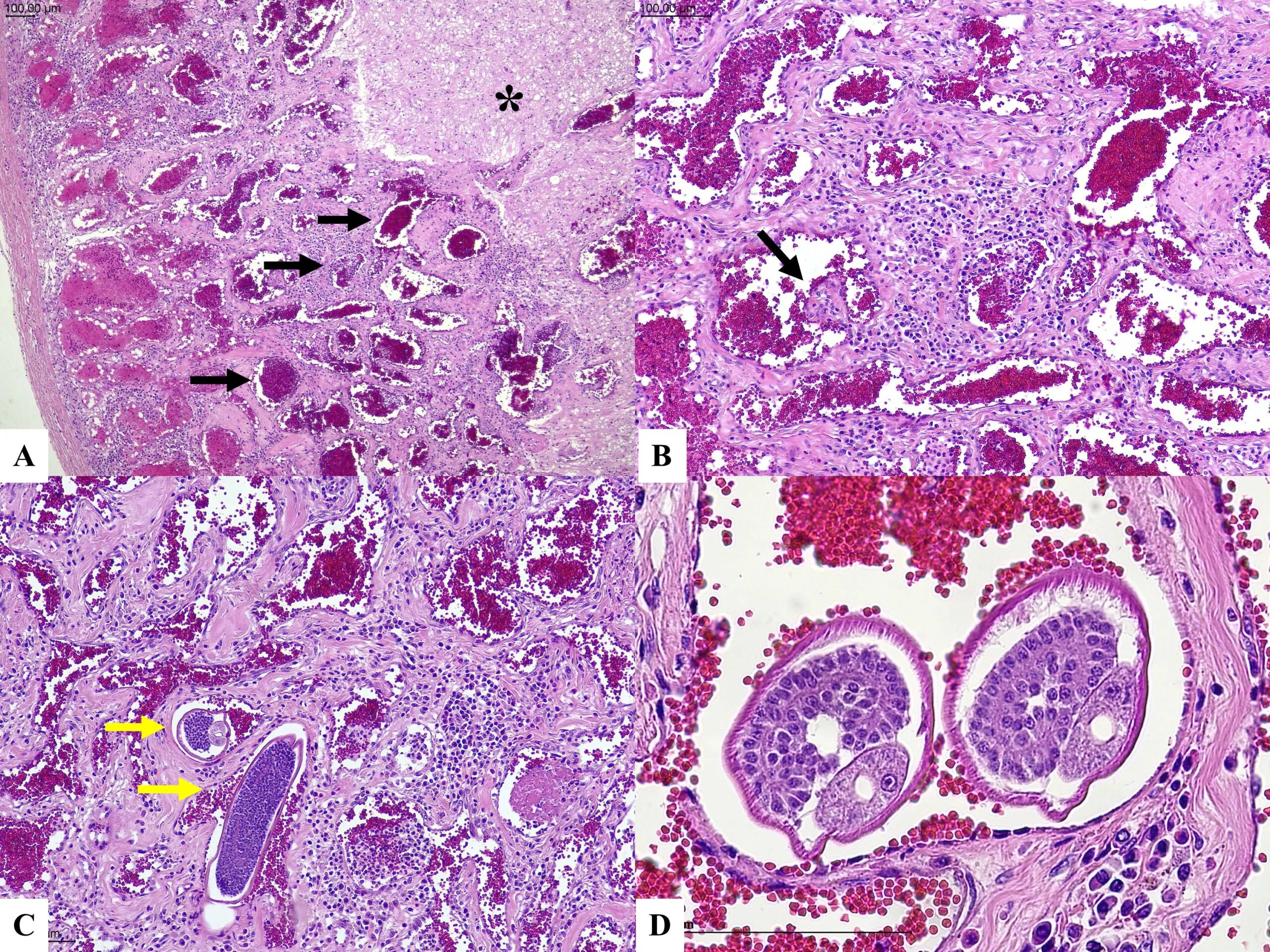
Gurltia paralysans is a nematode first described in 1933 in Chile, causing a syndrome called feline crural parasitic paraplegia. Insects, mollusks, frogs, lizards, and rodents are paratenic hosts of this nematode, and cats probably become infected by ingesting them. This report aims to discuss the main anatomopathological findings of gurltiosis in a cat submitted to necropsy in a laboratory in Ribeirão Preto city, São Paulo state, southeastern Brazil, being the first case reported in this state. The main necroscopic findings were extramedullary reddened areas below the leptomeninges in the cervical and lumbar segments of the spinal cord. The histopathological examination showed marked thickening of the leptomeninges in the lumbar segment of the spinal cord, with marked neovascularization and fibrosis associated with eosinophilic and mononuclear inflammatory infiltration, as well as the presence of intravascular nematodes. The diagnosis of this lesion was chronic segmental meningomyelitis associated with intralesional parasites. Although uncommon, feline gurltiosis is a neglected parasitic disease that should be included as a differential diagnosis of paraparesis in domestic cats.
Downloads

Published

2023-07-30

Issue

Section

Articles

How to Cite

Costa, R. R. M. E. da, Monteiro, J. E. H., Silva, C. de S., Ramos, F. R., Gouveia, B. A., Bertolo, P. H. L., & Vasconcelos, R. de O. (2023). Gurltia paralysans infection in a domestic cat in the São Paulo state, southeastern Brazil. Brazilian Journal of Veterinary Pathology, 16(2), 108-111. https://doi.org/10.24070/bjvp.1983-0246.v16i2p108-111