
Fine-needle aspiration cytology and cell block technique for grading canine mammary tumors: diagnostic feasibility and prognostic utility
DOI:
https://doi.org/10.24070/bjvp.1983-0246.019003Keywords:
agarose cell block, canine mammary tumors, cytopathology, fine-needle aspiration, grading, veterinary oncologyAbstract
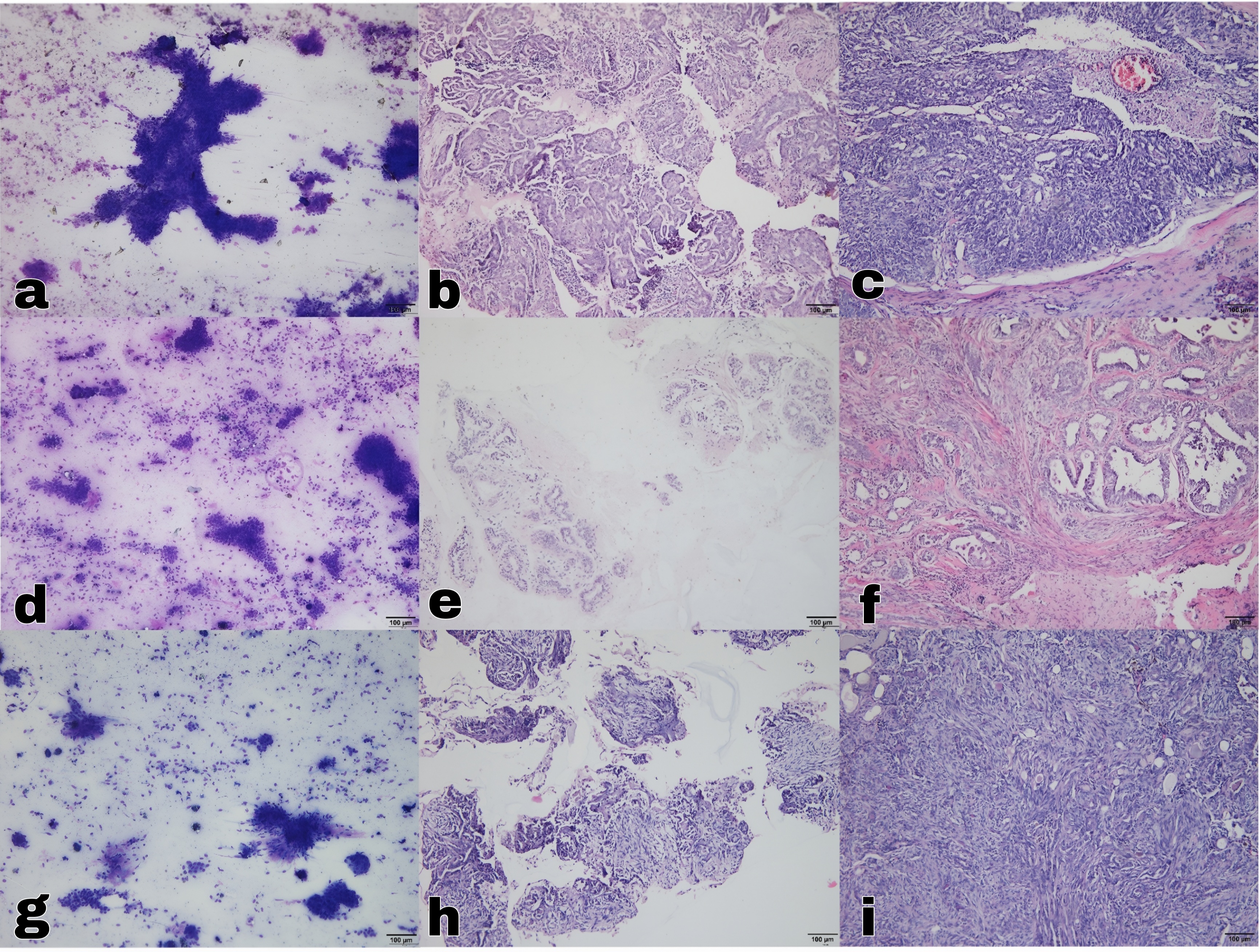
Fine-needle aspiration cytology (FNAC) is an essential tool for evaluating canine mammary tumors (CMTs), yet its accuracy for grading requires validation. This study aimed to evaluate the diagnostic accuracy, malignancy grading, and architectural patterns using FNAC and agarose cell block (CBA) compared to histopathology in 30 CMTs obtained from surgical specimens. Additionally, the correlation between cytological grading and sentinel lymph node metastasis was investigated. Diagnostic efficacy for malignancy was 90% for FNAC and 97% for CBA. Regarding malignancy grading, concordance with histopathology was 65% for FNAC and 95% for CBA. Moreover, CBA allowed for morphological classification, showing moderate agreement (60%; k=0.50) with histopathological subtypes. A significant positive correlation (p=0.016) was observed between FNAC malignancy grade and inguinal lymph node metastasis. In conclusion, CBA proves to be a promising tool for tumor grading and architectural assessment, while the proposed cytological grading system serves as a feasible prognostic indicator for metastatic risk, highlighting the need for future studies to validate these findings in clinical practice.
Downloads
Published
Issue
Section
License
Copyright (c) 2026 Brazilian Journal of Veterinary Pathology

This work is licensed under a Creative Commons Attribution 4.0 International License.


