
Causes of death in captive Psittaciformes in the Jaboticabal region, Brazil (2014-2024)
DOI:
https://doi.org/10.24070/bjvp.1983-0246.018015Keywords:
parrots, necropsy, preventive medicineAbstract
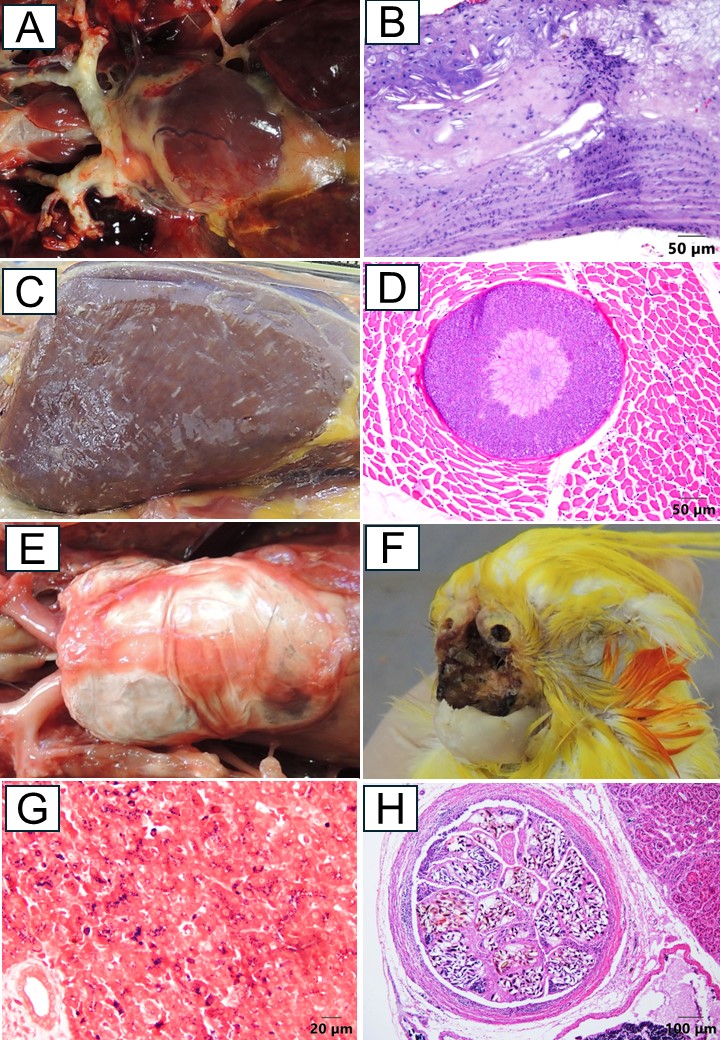
The necropsy of pet birds is an important tool for determining the cause of death and for identifying potential zoonotic or non-zoonotic etiological agents related to fatality. This retrospective study (2014 to 2024) aims to identify the main causes of death in Psittaciformes kept under human care in the Jaboticabal/SP region, Brazil. A total of 146 necropsy cases and histopathological analyses archived at the Wildlife Pathology Service of São Paulo State University, Jaboticabal campus, were examined. The most prevalently analyzed species included Amazona aestiva, Nymphicus hollandicus, and Ara ararauna, with a higher prevalence of adult birds and those from household environments. Causes of death were classified into infectious and non-infectious processes. Metabolic conditions, such as atherosclerosis, were the leading cause of death (14.3%), followed by trauma and poisonings. Among infectious causes, parasites of the genus Paratanaisia, as well as bacterial and fungal infections, were prominent. Difficulties in isolating infectious agents and carcass autolysis limited some diagnoses. The study reinforces the importance of necropsy as a diagnostic tool and highlights the need for preventive management practices tailored to birds in households, breeding facilities, and zoos. The findings highlight the importance of monitoring pre-mortem factors and implementing targetd preventive medicine strategies to improve the well-being and longevity of captive Psittaciformes.
References
Bavelaar FJ, Beynen AC. Atherosclerosis in parrots. a review. Vet Q. 2004;26(2):50-60. doi: 10.1080/01652176.2004.9695168.
Chalmers R, Cooper J, Ventura B. What are the priority welfare issues facing parrots in captivity? A modified Delphi approach to establish expert consensus. Anim Welf. 2024;33:e54. doi: 10.1017/awf.2024.57.
De Almeida GN, Ramos G, De Jesus LG, Branco MEC, De Azevedo CS, Sant’Anna AC. Temperament of Psittaciformes: a systematic review. Appl Anim Behav Sci. 2024; 277:106348. doi: 10.1016/j.applanim.2024.106348.
De Lucena Soares HK, Dos Santos Soares VM, De Faria Lopes S, De Lucena RFP, Barboza RRD. Rearing and trade of wild birds in a semiarid region of Brazil. Environ Dev Sustain. 2020;22(5):4323-39. doi: 10.1007/s10668-019-00386-5.
De Santi M, André MR, Lux Hoppe EG, Werther K. Renal trematode infection in wild birds: histopathological, morphological, and molecular aspects. Parasitol Res. 2018;117(3):883-91. doi: 10.1007/s00436-018-5767-0.
Fernandes Seixas GH, Mourão GDM. Nesting success and hatching survival of the Blue fronted Amazon (Amazona aestiva) in the Pantanal of Mato Grosso do Sul, Brazil. J Field Ornithol. 2002;73(4):399-409.
Fricke C, Schmidt V, Cramer K, Krautwald-Junghanns ME, Dorrestein GM. Characterization of atherosclerosis by histochemical and immunohistochemical methods in African Grey Parrots (Psittacus erithacus) and Amazon Parrots (Amazona spp.). Avian Dis. 2009;53(3):466-72. doi: 10.1637/8521-111908-Case.1.
Gibson DJ, Nemeth NM, Beaufrère H, Varga C, Eagalle T, Susta L. Captive Psittacine birds in Ontario, Canada: a 19-year retrospective study of the causes of morbidity and mortality. J Comp Pathol. 2019;171:38-52. doi: 10.1016/j.jcpa.2019.07.002.
Guimarães MB, Torres LN, Mesquita RG, Ampuero F, Cunha MPV, Ferreira TSP, et al. Clostridium perfringens type A enteritis in blue and yellow macaw (Ara ararauna). Avian Dis. 2014;58(4):650-3. doi: 10.1637/10855-043014-Case.1.
Katz ML, Robison WG. What is lipofuscin? Defining characteristics and differentiation from other autofluorescent lysosomal storage bodies. Arch Gerontol Geriatr. 2002;34(3):169-84. doi: 10.1016/s0167-4943(02)00005-5.
Lamarca D, Pereira D, Magalhães M, Salgado D. Climate change in layer poultry farming: impact of heat waves in region of Bastos, Brazil. Braz J Poult Sci. 2018;20(4):657-64. doi: 10.1590/1806-9061-2018-0750.
Mellor EL, McDonald Kinkaid HK, Mendl MT, Cuthill IC, Van Zeeland YRA, Mason GJ. Nature calls: intelligence and natural foraging style predict poor welfare in captive parrots. Proc R Soc B Biol Sci. 2021;288(1960):20211952. doi: 10.1098/rspb.2021.1952.
Meza-Madrid DI, Morales-Salinas E, Sánchez-Godoy FD. Pathological findings and their association with diseases of captive psittacine birds native to Mexico. J Comp Pathol. 2024;208:24-32. doi: 10.1016/j.jcpa.2023.11.005.
Monteiro Dos Santos D, Libonati R, Garcia BN, Geirinhas JL, Salvi BB, Lima E Silva E, et al. Twenty-first-century demographic and social inequalities of heat-related deaths in Brazilian urban areas. PLoS One. 2024;19(1):e0295766. doi: 10.1371/journal.pone.0295766.
Nemeth NM, Gonzalez-Astudillo V, Oesterle PT, Howerth EW. A 5-year retrospective review of avian diseases diagnosed at the Department of Pathology, University of Georgia. J Comp Pathol. 2016;155(2-3):105-20. doi: 10.1016/j.jcpa.2016.05.006.
Oliveira-Filho HS, Duarte JLC, Paranhos GF, Oliveira RL, Farias RC, Araújo JLD. Clinical and anatomopathological findings of lipid-related lesions in wild and pet birds from the State of Paraíba, Northeastern Brazil. Pesq. Vet. Bras. 2023;43:e07296. doi: 10.1590/1678-5150-PVB-7296.
Ottinger MA, Grace JK, Maness TJ. Global challenges in aging: insights from comparative biology and one health. Front Toxicol. 2024;6:1381178. doi: 10.3389/ftox.2024.1381178.
Pinheiro EDC, De Melo RC, Grespan A, Peixoto TMB, Dos Santos MH, Cabral LAR, et al. Heavy metal poisoning in a cockatiel (Nymphicus hollandicus). Acta Sci Vet. 2018;46:5. doi: 10.22456/1679-9216.85121.
Reavill DR, Dorrestein GM. Pathology of aging psittacines. Vet Clin North Am Exot Anim Pract. 2010;13(1):135-50. doi: 10.1016/j.cvex.2009.12.001.
Santi MD, Couto CD, Werther K. Occurrence of Paratanaisia spp. Freitas, 1951 in a domiciled cockatiel (Nymphicus hollandicus, Psittaciformes: Cacatuidae). Rev Bras Parasitol Vet. 2018;27(4):575-8. doi: 10.1590/s1984-296120180034.
Shuster KA, Brock KL, Dysko RC, DiRita VJ, Bergin IL. Polytetrafluoroethylene toxicosis in recently hatched chickens (Gallus domesticus). Comp Med. 2012;62(1): 49-52.
Silva ASG, Raso TF, Costa EA, Gómez SYM, Martins NRDS. Parrot bornavirus in naturally infected Brazilian captive parrots: challenges in viral spread control. PLoS One. 2020;15(6):e0232342. doi: 10.1371/journal.pone.0232342.
Soares HKL, Santos SS, Loures-Ribeiro A, Guzzi A, Lucena RFP. Breeding and management of wild birds in the semi-arid region of Paraíba, Brazil. Braz J Biol. 2024;84:e285304. doi: 10.1590/1519-6984.285304.
Young AM, Hobson EA, Lackey LB, Wright TF. Survival on the ark: life‐history trends in captive parrots. Anim Conserv. 2012;15(1):28-43. doi: 10.1111/j.1469-1795.2011.00477.x.
Zachary JF, editor. Pathologic basis of veterinary disease. Sixth edition. St. Louis, Missouri: Elsevier; 2017.
Downloads
Published
Issue
Section
License
Copyright (c) 2025 Brazilian Journal of Veterinary Pathology

This work is licensed under a Creative Commons Attribution 4.0 International License.


